The Dawn of Computing: When the Word Application First Appeared
The story of the origin of apps, or the origem dos aplicativos, begins long before anyone carried a phone in their pocket. In the 1950s, mainframe computers filled entire rooms. These massive machines were used by large corporations and government agencies for specific, repetitive tasks. It was during this decade that IBM first used the term application to describe a program designed for a particular purpose, such as managing inventory or tracking financial records. These early applications were not something a user could buy or download. They were custom-built by teams of programmers for a single organization, running on a single machine. The concept of an app as a discrete, shareable piece of software was still decades away.
The 1960s saw the emergence of the first general-purpose software. Programs like the Project Planner were developed for large mainframes and could handle mathematical calculations, data processing, and project scheduling. These were still tied to expensive, non-portable hardware, but they proved that software could be created for a wider range of tasks. The idea of a program that performed a function for the user became clearer during this period. Software was starting to separate itself from the hardware it ran on, though it was still far from being accessible to the average person.
The Personal Computer Revolution and the Birth of the Software Market
The 1970s brought a critical shift with the development of the first operating systems. Systems like CP/M and later MS-DOS allowed users to run different programs without having to rewrite the entire machine logic each time. This made it easier to create and distribute software for a standard platform. The rise of personal computers, such as the Apple II and the IBM PC, brought computing into smaller businesses and even some homes. Now, instead of just running pre-loaded functions, a user could insert a floppy disk and load a program to write a letter, manage a budget, or play a game. This was the true birth of the software market.
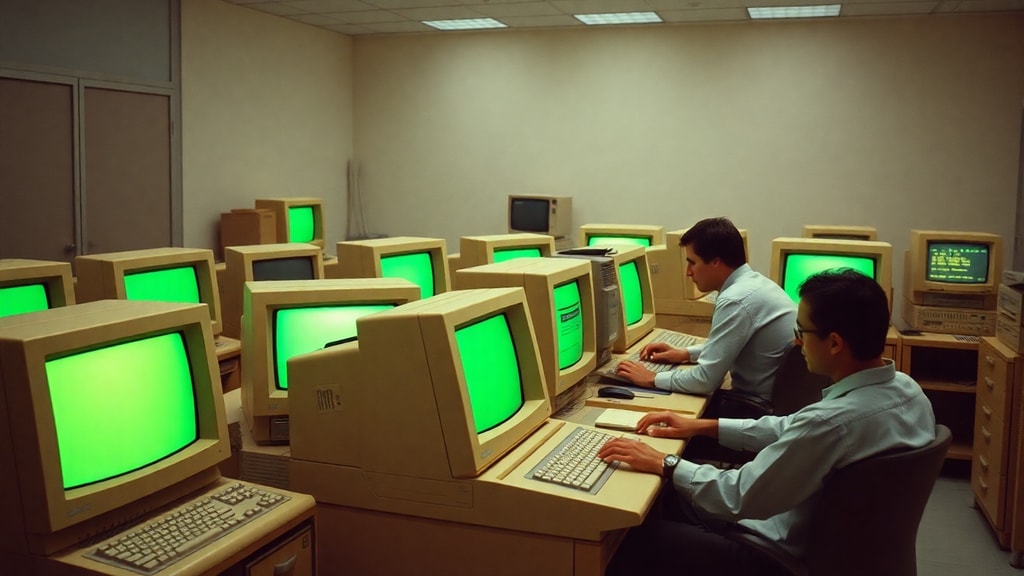
By the 1980s, the term application, or aplicativo in Portuguese, became the standard way to refer to software designed for specific user tasks on a personal computer. Companies like Lotus, Microsoft, and WordPerfect built entire businesses around selling individual applications. People began to understand that a computer was only as useful as the applications it could run. This era established the fundamental relationship between user, device, and software that we still see today. The idea that an application was a product you could purchase and install became a normal part of life for millions of people.
The 1980s also saw the rise of specific categories of applications. Word processors replaced typewriters. Spreadsheets transformed accounting. Database programs helped organize information. Games became a major driver for home computer sales. This period set the stage for the mobile revolution by proving that there was a massive demand for software that solved problems and provided entertainment. The main difference was that all these applications lived on a stationary machine that remained on a desk.
The First Smartphones and Early Mobile Software
The journey from desktop to mobile began in the 1990s. The IBM Simon, released in 1993 and 1994, is widely considered the first smartphone. It was a mobile phone that also included a calendar, address book, notepad, and even a few simple games. These were the first mobile apps, even though they were built directly into the device and could not be removed or added by the user. The Simon was a groundbreaking device, but it was expensive and far ahead of its time. Most people continued to use simple feature phones that could only make calls and send texts.
During the same decade, the infrastructure for selling digital software was being built. The Electronic AppWrapper, launched in 1991, is considered the first catalog for electronic app sales. It was a digital distribution platform for the NeXTSTEP operating system. Then, in 1996, SUSE opened what is often recognized as the first official online store for software. These early attempts at digital distribution showed that the internet could be used to deliver applications directly to users, bypassing physical packaging and retail shelves. However, the mobile audience was still very small.
The late 1990s gave the world the first globally popular mobile application: the Snake game on Nokia phones. Snake was pre-installed on millions of devices and demonstrated that people wanted to interact with their phones beyond just making calls. It was simple, addictive, and perfectly suited to the small screens and limited processing power of the time. Snake proved that mobile software had mass appeal, even if it was not yet possible to download new applications. The focus remained on basic games, calculators, and ringtone editors.
The iPhone, the App Store, and the Modern App Era
Everything changed in 2007. Apple launched the iPhone, a device that redefined what a mobile phone could be. The iPhone introduced the concept of mobile computing, with a full operating system, a touchscreen interface, and internet connectivity. Initially, the iPhone only ran applications that Apple had built, such as Safari, Maps, and Mail. However, the potential for third-party software was obvious. The device was essentially a small computer in your pocket, and it was only a matter of time before developers could write their own programs for it.
That moment arrived in 2008. Apple opened the App Store, a central marketplace where users could browse, download, and install applications directly onto their iPhones. At the same time, Google launched the Android Market, which later became Google Play. These two platforms changed the world. They created a simple, secure, and convenient way for developers to sell their software to a global audience. The App Store launched with just 500 applications, but it grew at an unprecedented rate. Within a year, there were over 100,000 apps available. The era of mobile applications had truly begun.
The impact of the App Store and Android Market was immediate and profound. Suddenly, anyone with an idea and some coding skills could create an application and distribute it to millions of users. This democratized software development and led to an explosion of creativity and innovation. Games, social networks, productivity tools, navigation apps, and countless other categories appeared overnight. The smartphone transformed from a communication device into a universal tool for daily life. The term app entered the common vocabulary, and the origem dos aplicativos became a story of how software moved from mainframes to desktops to the palm of your hand.
Key Milestones in the Evolution of Applications
The history of applications is marked by several key milestones that shaped the industry. The following list highlights some of the most important events:
- 1950s: IBM uses the term application for mainframe programs designed for specific business tasks.
- 1970s: The rise of personal computers and operating systems allows for the creation of standalone software products.
- 1980s: The term application becomes standard, and the commercial software market expands rapidly.
- 1993-1994: The IBM Simon is released, featuring the first set of built-in mobile applications.
- 1997-1998: The Snake game on Nokia phones becomes the first globally popular mobile app.
- 2007: Apple launches the iPhone, introducing a mobile computing platform designed for third-party software.
- 2008: The Apple App Store and Android Market open, marking the beginning of the modern app economy.
These milestones show a clear progression from specialized, custom-built programs to a universal marketplace accessible to everyone. Each step built on the previous one, creating the foundation for the billions of apps available today.
The App Economy Today: A Snapshot of the Industry
The app ecosystem has grown into a massive global industry. The following table provides a snapshot of the current state of the application market, based on recent data from industry reports:
| Metric | Estimated Value / Number | Notes |
|---|---|---|
| Number of available apps (iOS + Android) | Over 5 million | Combined total across both major platforms. |
| Annual global app revenue (2023) | Over $500 billion | Includes in-app purchases, subscriptions, and paid downloads. |
| Number of app downloads per year | Over 250 billion | Continues to grow year over year. |
| Average time spent on apps per day | Over 4 hours | Covers social media, games, productivity, and communication. |
The table demonstrates the sheer scale of the app industry today. What started as simple programs on mainframes has become a central part of the global economy and daily life for billions of people. The origem dos aplicativos is a story of constant evolution, driven by technological advances and changing user needs.
Conclusion and References
The origin of apps is a fascinating journey that spans more than half a century. From the massive mainframes of the 1950s where the term application was first used, to the personal computers of the 1980s that created a software market, and finally to the smartphones of the 2000s that put an app in every pocket, the evolution has been remarkable. The IBM Simon and the Nokia Snake game were early hints of what was to come, but it was the combination of the iPhone, the App Store, and the Android Market that truly launched the modern app era. Today, applications are essential tools for communication, work, entertainment, and commerce. Understanding this history helps us appreciate how far we have come and how much further we can go. For more detailed information on this topic, you can explore the timeline of apps on Showmetech and read about the brief history of applications on Scribd.
References
Showmetech. A Historia dos Apps: Da Origem ao Sucesso dos Smartphones. Available at: https://www.showmetech.com.br/a-historia-dos-apps/
Scribd. Breve Historia Dos Aplicativos. Available at: https://www.scribd.com/document/934213217/Breve-Historia-Dos-Aplicativos
Scribd. DOC-20240627-WA0006 (IBM Simon details). Available at: https://www.scribd.com/document/745956564/DOC-20240627-WA0006
Showmetech. A Historia dos Apps (Steve Jobs and App Store vision). Available at: https://www.showmetech.com.br/a-historia-dos-apps/