What Is a Croqui? An Introduction to Rapid Sketching
A croqui is a quick, rough, preliminary sketch or drawing made freehand. Its purpose is not perfection but rather the rapid capture of an idea, a scene, or a form. The word comes directly from the French term croquis, which itself derives from the verb croquer. This verb carries a dual meaning: to sketch rapidly and to crunch, as in the sound of biting into something crisp. This origin perfectly describes the nature of a croqui. It is a quick, biting capture of visual information, done before the details can fade or before the mind can overthink the form. Unlike a finished illustration or a technical blueprint, a croqui is informal, non-metric, and expressive. It serves as a visual note, a first impression, or a foundation upon which more developed work can be built. For beginners, understanding the croqui is the first step toward confident drawing and visual thinking.
The Origins of the Croqui: A French Legacy in Design
The history of the croqui is deeply tied to the traditions of French art and design. In the 18th and 19th centuries, artists and architects used quick sketches to record observations from life. The practice became especially common among students at the Ecole des Beaux-Arts in Paris, where rapid sketching was a core skill. The term croquis entered the English language around the 1800s, carrying with it the idea of a swift, unpolished drawing. Today, the word and the technique are used globally, though the French spelling sometimes simplifies to croqui in other languages. The core idea remains unchanged: a croqui is a tool for thinking on paper, a way to test proportions, and a method for capturing the essence of a subject without getting lost in details. This historical context explains why fashion designers, architects, and illustrators still rely on croquis today. They are continuing a tradition that values speed, observation, and creative flow.
Key Characteristics of a Croqui
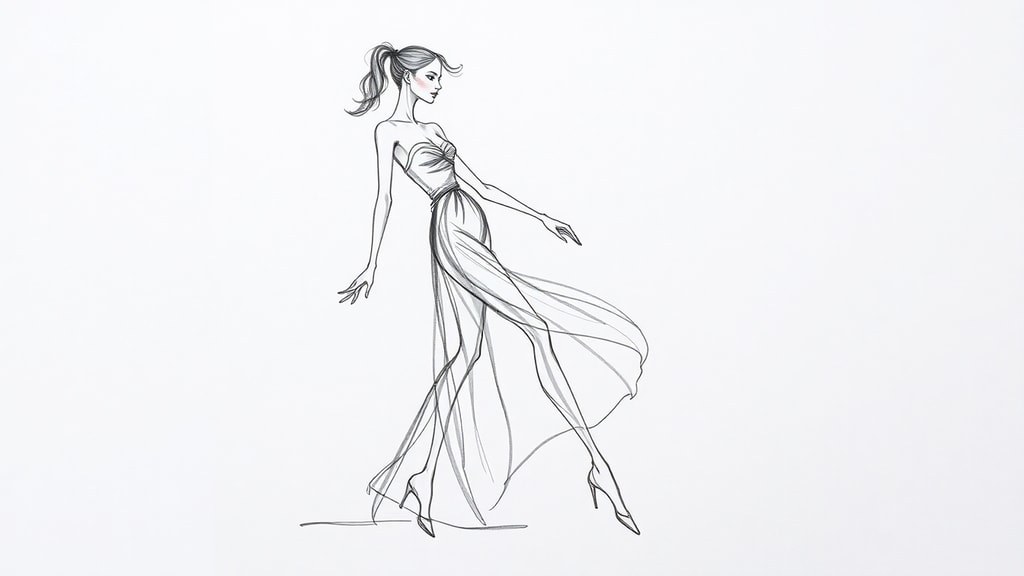
What separates a croqui from other types of drawings? Several distinct characteristics define this form of sketching. First, speed is essential. A croqui is made quickly, often in just a few minutes. The goal is to record the main idea before it vanishes. Second, the drawing is always freehand. No rulers, compasses, or measuring tools are used. This hand-drawn quality gives the croqui its energy and life. Third, a croqui prioritizes agility, perception, and expression over precision. Mistakes are not erased but are left as part of the process. Fourth, the sketch serves as a foundation for more detailed work. A croqui is not an endpoint. It is a starting point for a technical drawing, a painting, or a finished design. Finally, a croqui is informal. It can be drawn on any paper, in any notebook, or even on a napkin. The setting does not matter. What matters is the act of capturing an idea.
These characteristics make the croqui an indispensable tool for any visual thinker. Whether you are planning a building, designing a dress, or sketching a street scene, the croqui helps you work out your ideas physically.
Common Uses of the Croqui in Different Fields
The croqui is a universal tool across many creative disciplines. Below is a table summarizing the primary fields where croquis are used and their specific purposes.
| Field | Purpose of the Croqui | Typical Focus |
|---|---|---|
| Fashion Design | To draw garment ideas on a standardized body template | Proportions, drape, silhouette, color blocks |
| Architecture | To explore building forms, spatial relationships, and site layouts | Volume, massing, light, shadow, basic structure |
| Interior Design | To plan room layouts, furniture placement, and flow of space | Scale, sightlines, function, mood |
| Illustration and Fine Art | To capture live models, landscapes, or compositional ideas | Gesture, movement, expression, basic shapes |
| Graphic Design | To brainstorm logos, layouts, and visual concepts rapidly | Balance, hierarchy, contrast, alignment |
Each field adapts the croqui to its own needs, but the underlying principle remains the same. The croqui is a fast, intuitive way to move an idea from the mind to the page. For beginners, practicing croquis in any of these areas will build both confidence and skill.
The Croqui in Fashion Design: A Special Case
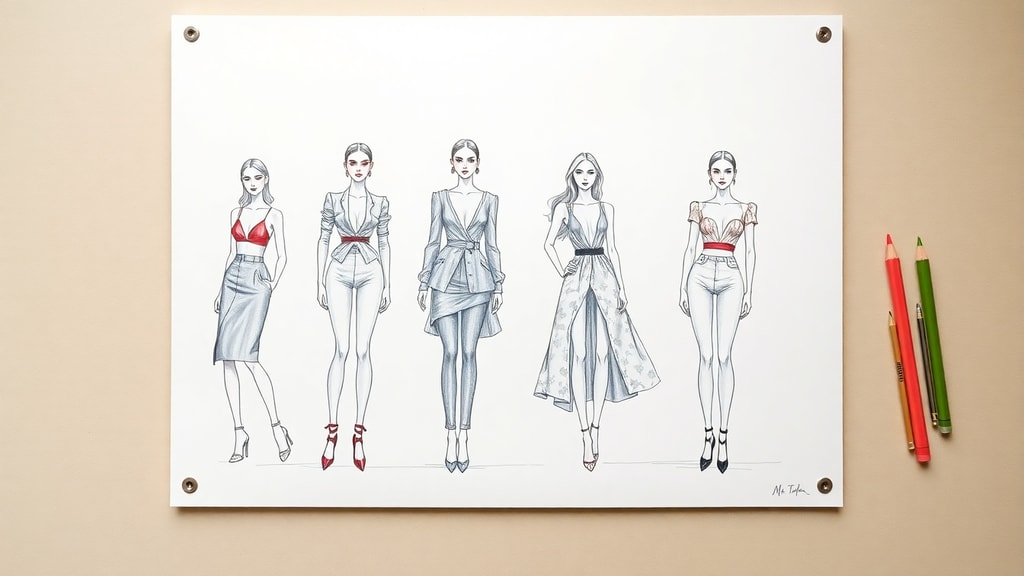
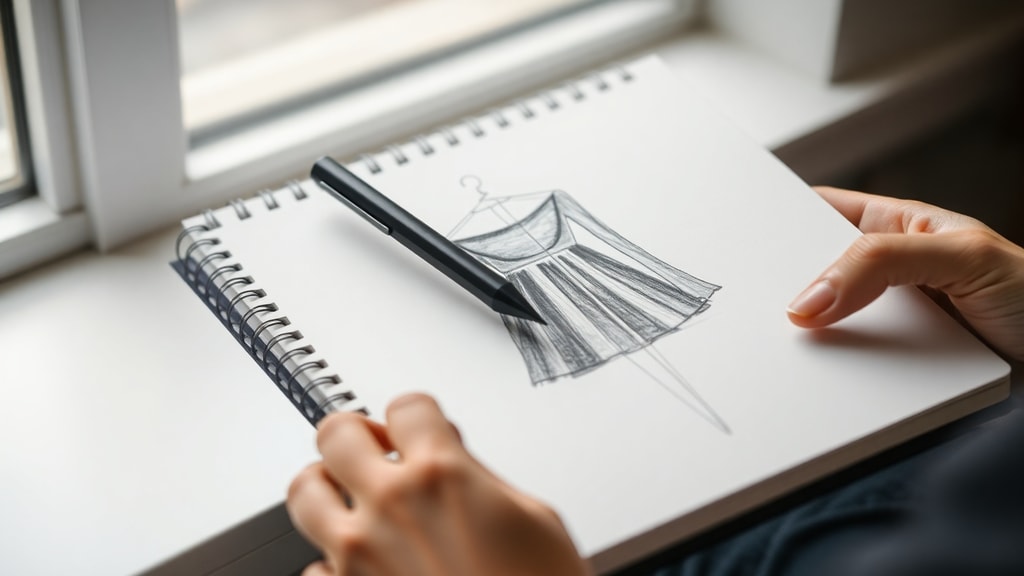
In fashion, the term croqui has a specific and widely used meaning. It refers to a proportioned body silhouette, typically nine heads tall, used as a template for drawing clothing. This elongated figure is not meant to represent an average human body. Instead, it is a stylized form that emphasizes the clothing itself. The nine-head proportion creates a tall, lean figure that allows the garment details to stand out. Fashion designers often create their own croqui templates and then photocopy or trace them many times. Every new design begins with the same basic body. The designer then sketches the garment over the croqui, adding folds, colors, and textures. This practice is essential for fashion students and professionals alike. Learning to draw a fashion croqui is one of the first skills taught in design schools. It provides a consistent framework that makes comparing different designs easier. For anyone starting in fashion, mastering the croqui is a foundational step.
How to Start Sketching Croquis: A Beginner s Guide
Starting with croquis is simple. You do not need expensive materials. A pencil, a pen, and any piece of paper are enough. The most important thing is the willingness to draw quickly and without fear of mistakes. Here is a list of steps to help you begin:
- Choose a subject. It can be a person, an object, a building, or even a scene from your imagination.
- Set a time limit. Start with five minutes per sketch and gradually reduce to two or even one minute.
- Focus on the overall shape first. Do not get caught in details like eyes, windows, or buttons.
- Use continuous lines. Keep your hand moving. Stopping and starting will make the sketch stiff.
- Draw the same subject multiple times. Each attempt will be different and will teach you something new.
- Do not erase. If you make a line you do not like, draw another one next to it. The overlapping marks add character.
- Practice daily. Even ten minutes of sketching will improve your observation and hand coordination.
As you practice, you will notice that your hand becomes faster and your eye becomes sharper. The croqui is not about making a pretty picture. It is about training yourself to see and record what matters most. For more guidance on developing your drawing skills, you can explore resources on basic sketching techniques at Merriam-Webster for the official definition, or visit Wikipedia for a detailed historical overview.
Why Croquis Are Essential for Visual Thinking
Visual thinking is the process of solving problems and generating ideas through images rather than words. The croqui is one of the most effective tools for this kind of thinking. When you draw a croqui, you are not just recording what you see. You are analyzing it. Your brain is breaking down a complex scene into simple shapes and lines. This act of simplification helps you understand the underlying structure of any subject. For architects, a croqui can reveal how light moves through a space. For designers, it can show how a garment will fall on a body. For illustrators, it captures the gesture of a moving figure. The croqui forces you to decide what is essential and what is not. This skill transfers directly to any creative work. Beginners often struggle with perfectionism. The croqui is the perfect antidote. It teaches you that a rough sketch is better than no sketch at all. Every great design, every masterpiece, begins as a croqui.
Common Mistakes Beginners Make and How to Avoid Them
When starting with croquis, beginners often fall into predictable traps. One common mistake is trying to make the sketch look finished. A croqui is not meant to be a polished artwork. If you find yourself erasing or adding tiny details, you are missing the point. The solution is to set a strict time limit and stick to it. Another mistake is drawing too small. Small sketches limit your movement and make it harder to capture gestures. Draw large, using your whole arm, not just your wrist. A third mistake is using the same pose or subject every time. This leads to stagnation. Challenge yourself by drawing different shapes, angles, and movements. Finally, many beginners compare their sketches to professional examples. This can be discouraging. Remember that every expert was once a beginner. The goal of a croqui is to improve your personal ability to see and record, not to match someone else s style. Keep your early sketches, too. They will show you how much you have progressed.
Tools and Materials for Croqui Sketching
You do not need much to start making croquis. The most important tool is a sketchbook with good quality paper that can handle both pencil and light ink. For pencils, a medium hardness like HB or B works well. Softer pencils like 2B or 4B are good for darker lines and shading. Pens are also popular for croquis because they force you to commit to each line. A fine-liner pen with a 0.5 or 0.7 mm tip is excellent. Some artists use markers for quick color blocking. Beyond materials, the physical environment matters. Find a place where you can draw without interruption. Natural light is best for seeing values and shadows. As you advance, you might experiment with different tools, but never let the lack of materials stop you. A croqui drawn with a ballpoint pen on a scrap of paper is just as valuable as one drawn with expensive supplies. The skill is in your hand and your eye, not in your materials.
Integrating Croquis into Your Creative Workflow
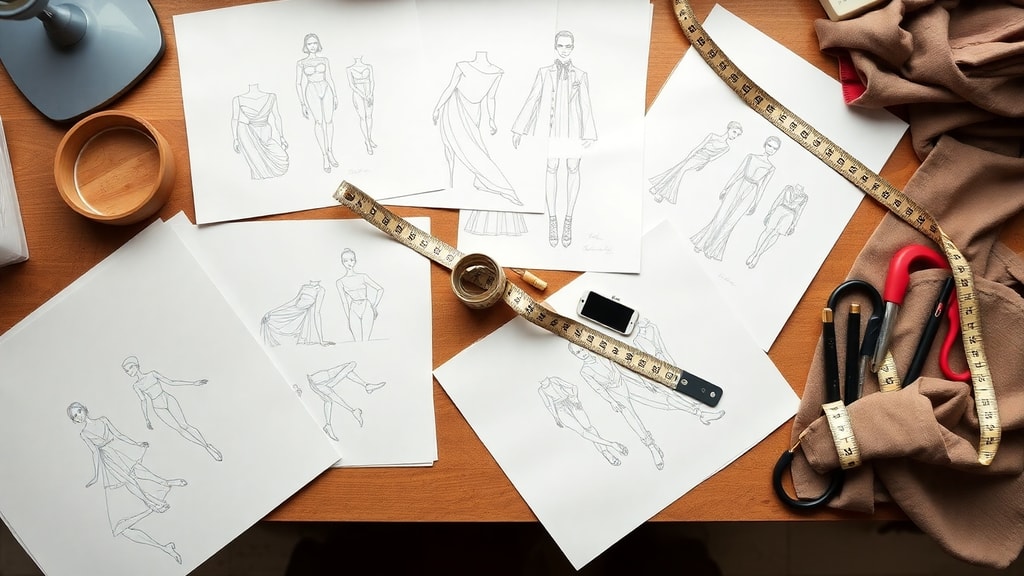
Once you are comfortable with the basics, you can make croquis a regular part of your creative process. Many professionals use croquis in the early stages of a project. They might fill an entire sketchbook with quick ideas before selecting one to develop further. For fashion designers, this means dozens of croqui templates with different necklines, sleeves, and skirts. For architects, it means pages of building shapes and floor plans. For illustrators, it means gesture drawings of models in various poses. The croqui serves as a visual diary of your thinking. Over time, you will develop a personal style and a library of forms that you can reuse. The key is to keep the practice consistent. Set aside 15 minutes each day for quick sketching. Use it as a warm-up before more detailed work. The more you draw, the more natural it becomes. Eventually, you will find that your hand can keep up with your imagination.
References
This article draws on definitions and historical context from the following reputable sources. Dicio defines croqui as a rapid sketch used in design and architecture. Michaelis provides the Portuguese language definition. Wikipedia offers a comprehensive English overview of croquis in art and design. Merriam-Webster provides the English dictionary entry for croquis. The design school 4ED explains its use in fashion and architecture. Escreva.ai gives a clear definition in Portuguese. Wiktionary traces the etymology from French. Arch Glass includes the term in its glossary of glass industry terms. Concepto.de offers a Spanish-language definition. OqueSignifica.com provides another Portuguese-language meaning. All sources confirm the core idea of a quick, freehand sketch used for idea development.