Understanding US Size Charts
When shopping for clothing or shoes from American brands, understanding the US size chart is essential to ensure a proper fit. Unlike many other countries that use metric measurements or a different numbering system, the United States relies on inches and a unique set of size labels. For anyone accustomed to Brazilian sizing, the differences can be confusing. This guide provides a comprehensive overview of US size charts for clothing and shoes, including conversion tables, measurement tips, and the key distinctions between men's, women's, and children's sizes. Whether you are ordering online from an American store or preparing for a trip to the United States, knowing how to interpret these charts will save you time and reduce the risk of returns.
The US standard uses inches for body measurements such as chest, waist, hips, and inseam. For example, a men's suit jacket is often labeled with a number like 40R, representing the chest circumference in inches with a regular length. Similarly, jeans and trousers list two numbers separated by a slash, such as 34/32, where the first number is the waist measurement and the second is the inseam length. Women's clothing uses even-numbered sizes starting from 0 and going up, while children's sizes are based on age, height, or weight. Understanding these fundamentals is the first step to using a tabela de tamanhos eua correctly.

Men's Clothing Sizes: From Shirts to Pants
Men's tops in the US are commonly sold using letter sizes: S, M, L, XL, and so on. However, these letters correspond to specific chest measurements in inches. For instance, a US Small typically fits a chest of 34-36 inches, while a Medium fits 38-40 inches. When converting from Brazilian sizes, the following general correspondence applies:
- Brazilian size 38-40 equals US Small (S)
- Brazilian size 42 equals US Medium (M)
- Brazilian size 44-46 equals US Large (L)
- Brazilian size 48-50 equals US Extra Large (XL)
For dress shirts, the US uses neck and sleeve measurements in inches. A common size would be 15.5/32, meaning a 15.5-inch neck and a 32-inch sleeve. This is more precise than letter sizes and is preferred for formalwear.
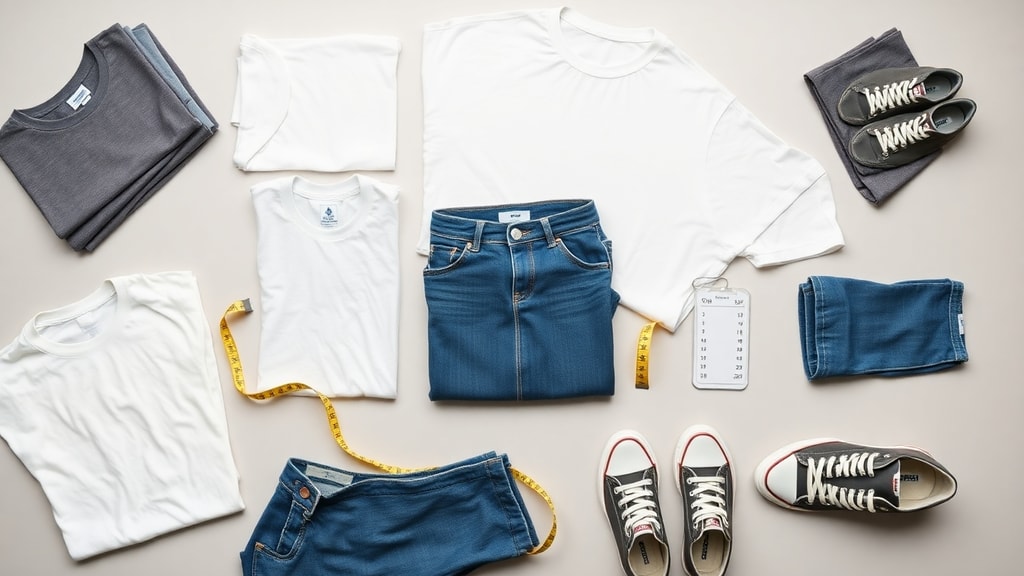
Men's pants are sized by waist and inseam. The waist measurement in inches is the first number, and the inseam length is the second. For example, a pair of jeans labeled 34/32 fits a 34-inch waist and a 32-inch inseam. The conversion from Brazilian to US waist sizes is fairly consistent:
| Brazilian Waist Size | US Waist (inches) |
|---|---|
| 38-40 | 30 |
| 42 | 32 |
| 44-46 | 34 |
| 48-50 | 36 |
It is important to note that brands may cut their garments differently. Some jeans are labeled as "slim fit" or "regular fit," which can affect how they sit on the body. Always check the specific brand's size chart when available. For more detailed tables, you can visit Roteirize's complete conversion guide.

Women's Clothing Sizes: Numeric System and Conversion
Women's clothing in the US uses even numbers ranging from 0 (sometimes 00) up to 20 or more. Unlike men's sizes, women's sizes are not directly based on a single measurement but rather on a combination of bust, waist, and hip measurements. The Brazilian system uses numbers like 34, 36, 38, 40, etc., which are different from the US system. The typical conversion is as follows:
- US size 4 corresponds to Brazilian size 36
- US size 6 corresponds to Brazilian size 38
- US size 8 corresponds to Brazilian size 40
- US size 10 corresponds to Brazilian size 42
These conversions are approximate and can vary by brand. For dresses, the US also uses letter sizes (XS, S, M, L, XL), but they are less common for fitted garments. It is advisable to take your bust, waist, and hip measurements in inches and compare them to the brand's size chart. Remember that one inch equals 2.54 centimeters. If you measure yourself in centimeters, divide by 2.54 to get inches before consulting the chart.
Shoe Size Conversions: Men, Women, and Children
US shoe sizes are different from European and Brazilian sizing. The US uses a separate scale for men and women, and children have their own scale as well. For men, a US size 7 is equivalent to a European size 40 and a Brazilian size 38. A US size 9 is the same as EU 42 and BR 40. For women, the conversion is slightly different: a US size 6 equals EU 36.5 and BR 36, while a US size 8 equals EU 38.5 and BR 38. These numbers are rough guides, and the actual fit can depend on the shoe style and manufacturer.
Children's shoe sizes in the US are generally based on the length of the foot in inches. There are also separate scales for toddlers and older children. The US children's size system is not directly compatible with the Brazilian system, so it is best to measure the child's foot length in inches and then look up the appropriate size. Many US shoe retailers provide detailed foot measuring instructions on their websites. For a reliable conversion tool, you can check OneGoviaja's size guide.

How to Measure for US Sizes
To use a US size chart accurately, you need to take your body measurements correctly. For men, the key measurements are chest, waist, hips, and inseam. The chest is measured around the fullest part, keeping the tape measure horizontal. The waist is measured at the natural waistline, usually just above the belly button. The inseam is measured from the crotch to the bottom of the ankle along the inside of the leg. For women, add the bust measurement at the fullest point of the chest, and the hip measurement at the widest part of the hips. Record all measurements in inches, rounding to the nearest half inch.
When measuring for shoes, it is best to trace your foot on a piece of paper while standing, then measure the length from heel to longest toe. For children, the same method applies. Shoe size charts typically list foot length in inches or centimeters. Remember that US shoe sizes are not linear with foot length in the same way as European sizes, so always use a conversion table.
Common Pitfalls When Using US Size Charts
One of the most common mistakes is assuming that a US size corresponds exactly to the same number in another system. For example, a US women's size 8 is not the same as a Brazilian 40 in all brands; the cut and target customer can differ. Another pitfall is ignoring the letter modifiers such as "Petite," "Tall," or "Plus." These indicate adjustments in length and width for different body types. Additionally, shirt sizes for men often combine neck and sleeve measurements, so buying a shirt based only on the letter size may result in poor fit if your sleeve length differs from the standard.
It is also worth noting that vintage or thrift store clothing may use older sizing standards, which can run smaller than modern sizes. When in doubt, contact the seller for exact measurements of the garment. Knowing your exact body measurements in inches is the most reliable way to shop US brands.
References
The information presented in this article is based on widely used conversion tables and reputable sources for US size charts. For further detail on specific measurements and brand variations, the following sources provide additional guidance: Roteirize offers a comprehensive Brazilian-to-US clothing and shoe conversion chart with explanatory notes. OneGoviaja provides a practical converter for travelers and online shoppers, along with inch measurement instructions. Postalboxusa supplies general conversion tables for clothing and shoes across multiple countries. Finally, Significados presents a straightforward overview of size equivalents for common garment types.